
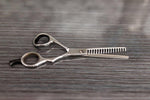
If your thinning scissors feel clumsy in your hand or you are not getting even results, the problem is almost certainly size. The right pair should sit naturally in your palm with the blade tip extending just past your middle finger. For most female stylists, that means a 5.5 to 6.0 inch shear. For most male barbers and stylists with larger hands, 6.0 to 6.5 inches is the sweet spot. Get the sizing wrong and you will fight the scissors all day instead of letting them do the work.
The Quick Answer: Match the Scissors to Your Hand
There is a simple test that has been taught in hairdressing schools for decades. Hold your hand out flat with your fingers together. Measure from the tip of your middle finger to the base of your palm where it meets your wrist. That measurement is your ideal overall scissor length, including the handle.
For the blade specifically, measure from the tip of your middle finger to the first knuckle crease. That gives you the blade length that will feel most natural when opening and closing the shear. A blade that is too short makes you over-work your thumb. A blade that is too long makes precise control harder, especially around the ears and nape.

Thinning Scissor Size Guide
This table covers the full range of thinning scissors from student sizes up to long barber shears. Use it as a starting point, then adjust based on what feels right in your hand.
| Size | Best For | Typical User | Use Case |
|---|---|---|---|
| 4.5 - 5.0" | Small hands, precision work | Students, petite stylists | Fringe work, around the ears, detail texturising |
| 5.5" | General salon thinning | Female stylists (most common) | All-round salon thinning, layering, blending |
| 6.0" | Versatile mid-range | Male and female stylists | Everyday thinning, texture work, graduation |
| 6.5" | Larger hands, barbering | Male stylists, barbers | Scissor-over-comb thinning, bulk removal |
| 7.0"+ | Long hair, over-comb work | Barbers, long-hair specialists | Deep bulk removal, long layers, barbering |
Does Tooth Count Matter as Much as Size?
Size determines comfort and reach. Tooth count determines how much hair each cut removes. They work together, and getting one right while ignoring the other leads to problems.
- 40+ teeth — removes very little per cut. Ideal for subtle texturising on fine or medium hair. Forgiving for beginners because over-thinning is harder
- 30 to 40 teeth — the standard range for salon work. Removes a moderate amount per pass. This is what most hairdressers reach for daily
- 20 to 30 teeth — more aggressive. Takes out noticeable bulk with each cut. Good for very thick, coarse hair
- Under 20 teeth (chunkers) — dramatic removal. Used sparingly on extremely thick hair or for creating deliberate chunky texture
As a rule of thumb: if you are unsure, start with a 30 to 40 tooth thinner in whatever size fits your hand. You can always make a second pass. You cannot undo a pass with a 15-tooth chunker.
Choosing Size Based on Hair Type
The hair you work with most should influence your choice:
Fine or thin hair — go shorter (5.0 to 5.5 inches) with a high tooth count (40+). Shorter blades give you more control, and more teeth mean you will not accidentally take out too much. Every strand matters on fine hair.
Medium, straight or wavy hair — the 5.5 to 6.0 inch range with 30 to 40 teeth covers nearly every situation you will encounter in a typical salon day.
Thick, coarse or curly hair — a longer thinner (6.0 to 6.5 inches) with fewer teeth (25 to 35) lets you cover more ground and remove meaningful bulk. Thick hair can absorb aggressive thinning without looking sparse.
Barbering and men's cuts — barbers tend to prefer 6.0 to 7.0 inch thinners for scissor-over-comb work. The extra length is useful when working the comb up the back and sides. A 6.5 inch, 30-tooth thinner is a popular all-rounder for barbershop work.
A Note for Students and Apprentices
When I was learning, everyone in my class started with 5.0 to 5.5 inch thinners because that is what the school supplied. I have larger hands and my instructor noticed I was gripping too tightly to compensate for the short handles. She suggested I try a 6.5 inch pair and the difference was immediate. My hand relaxed, my wrist stopped aching at the end of the day, and my thinning became more even.
If you are buying your first pair, do not just order whatever your classmate has. Measure your hand, try a few sizes if your school or supplier allows it, and pay attention to how your hand feels after a full day of cutting. Comfort beats everything else.
Browse our full range of thinning scissors or read more about how to use thinning scissors and how to measure hairdressing scissors.
Frequently Asked Questions
What size thinning scissors should a beginner get?
Start with whatever fits your hand using the middle-finger measurement described above. For most beginners, that will be a 5.5 or 6.0 inch shear with 35 to 40 teeth. The higher tooth count is more forgiving while you develop your technique.
Can you use 6.5 inch thinning scissors on short hair?
You can, but a shorter shear (5.0 to 5.5 inches) gives better control on short styles, especially around the ears, nape, and fringe. Long thinners are better suited to scissor-over-comb work and bulk removal on longer hair.
Does scissor size affect how much hair is removed?
Indirectly. A longer blade covers a wider section of hair per cut, so each pass affects more hair. But the tooth count is the primary factor in how much hair is removed per cut, not the blade length. A 7 inch, 40-tooth thinner removes less per pass than a 5.5 inch, 20-tooth chunker.
Tags
Blog posts