
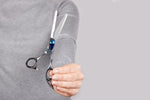
When holding thinning scissors, the toothed blade should face upward toward the ceiling and the smooth cutting blade should face downward toward the floor. When viewed from the side, the teeth should face outward (away from the head) and the cutting blade should face inward. This orientation ensures clean, even thinning without tugging or pulling hair.
Which Way Up Should Thinning Scissors Face?
Thinning scissors have two distinct blades: one with teeth (the thinning blade) and one smooth (the cutting blade). The correct orientation is always:
- Teeth facing up (toward the ceiling) when cutting horizontally
- Teeth facing outward (away from the client's head) when cutting vertically or at an angle
- Cutting blade facing inward (toward the hair you're thinning)
This orientation allows the teeth to catch and guide individual strands into the cutting blade, which then shears them cleanly. If the teeth face the wrong direction, they push hair away rather than drawing it in, leading to an uneven result and potential damage.

How to Hold Thinning Scissors Correctly
Proper grip is just as important as orientation. Follow these steps for the correct hold:
- Place your ring finger through the bottom ring (the one connected to the smooth blade)
- Place your thumb through the top ring (connected to the toothed blade)
- Rest your little finger on the finger rest (tang) for stability
- Your index and middle fingers rest along the shank of the bottom blade for control
- Only move your thumb when opening and closing — the bottom blade stays still
The tension screw should be positioned so the scissors open and close smoothly without wobbling. If the blades feel loose or stiff, adjust the tension screw slightly.
What Happens If You Hold Them the Wrong Way?
Holding thinning scissors with the teeth facing downward or inward causes several problems:
- Tugging and pulling — the teeth grab hair instead of guiding it, causing discomfort for the client
- Uneven thinning — hair is removed in clumps rather than evenly distributed strands
- Breakage and split ends — the tearing action damages hair shafts rather than cutting them cleanly
- Client discomfort — the pulling sensation is immediately noticeable and uncomfortable
Professional hairdressers can tell within the first snip if the orientation is wrong because the scissors will feel resistant and the hair will not separate cleanly through the teeth.
Left-Handed vs Right-Handed Thinning Scissors
If you are left-handed, you need left-handed thinning scissors. The toothed blade is on the opposite side compared to right-handed models, so the teeth still face outward when held in the left hand.
Using right-handed thinning scissors in your left hand reverses the blade orientation. The teeth face inward rather than outward, which causes the same tugging and damage problems described above. Always use scissors designed for your dominant hand.
Thinning Scissors vs Texturising Scissors — Does Orientation Differ?
Both thinning scissors and texturising scissors follow the same orientation rule: teeth up, cutting blade down. The difference is in the tooth count:
- Thinning scissors (30-40 teeth) — remove less hair per cut, more subtle thinning
- Texturising scissors (7-16 teeth) — remove more hair, creating chunkier texture
- Chunkers/Chompers (5-9 teeth) — remove the most hair, for dramatic volume reduction
Regardless of tooth count, the teeth always face upward and outward. The wider gaps between teeth on texturising scissors make correct orientation even more important, as incorrect positioning causes more aggressive tugging.
Frequently Asked Questions
Should the teeth of thinning scissors face up or down?
The teeth should always face upward toward the ceiling when cutting horizontally. When cutting at an angle or vertically, the teeth should face outward, away from the client's head. The smooth cutting blade faces downward or inward.
Can you damage hair by holding thinning scissors the wrong way?
Yes. Incorrect orientation causes the teeth to push against hair rather than guiding it into the cutting blade. This results in tugging, pulling, breakage, and split ends. The damage is especially noticeable on fine or already-processed hair.
Is there a difference between left and right-handed thinning scissors?
Yes. Left-handed thinning scissors have the toothed blade on the opposite side so the teeth face outward when held in the left hand. Using right-handed scissors in the left hand reverses the blade orientation and causes cutting problems. Always use scissors designed for your dominant hand.
Read more about how to use thinning scissors or browse our thinning scissors collection.
Tags
Comments
-
Fantastic! I’ve heard people say the devil is in the details so thanks for this easy peasy explanation on how you hold thinning scissors. When it comes to cutting hair, you need more than the right hair cutting scissors, you need the knowledge of how to use them, hold them, and when to use them. Hair cutting isn’t as easy as it might look.
-
So simple yet I had no idea! I started using thinning scissors this year and I have been enjoying to results but I noticed that my hand cramps and I have to turn my fingers in an awkward way to get the right cut. Little did I know, I was holding them the wrong way! I wish someone had told me but I guess people just assumed it was how I used them since I got the desired results. Those look like a fantastic pair of scissors. I kind of want them! Look a lot better than the ones I got on Amazon.
Blog posts