
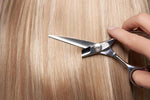
Slide cutting is a texturising technique where you open the scissors slightly and glide them along the hair shaft from mid-lengths to ends, removing bulk and creating soft, tapered movement without blunt lines. It is one of the most useful techniques in a hairdresser's toolkit, but it requires sharp scissors, a light hand and a clear understanding of when to use it and when to leave it alone.
What Is Slide Cutting?
Slide cutting (sometimes called slithering) is a freehand technique where the scissors stay partially open while moving along the hair. Unlike point cutting, which removes small pieces from the ends, slide cutting works along the length of the strand to thin, taper and blend. The result is soft, natural-looking texture with no hard lines or visible steps.
The technique originated in European salons but has become standard training in most hairdressing academies. It sits alongside freehand cutting and dry cutting as a finishing technique used after the structural cut is complete.

How to Slide Cut: Step by Step
Before you start, make sure your scissors are sharp. Slide cutting with dull blades will catch, pull and damage the hair. You need a convex-edge scissor in good condition.
- Section the hair. Work in thin, clean sections. The thinner the section, the more control you have over how much bulk you remove.
- Hold the section at tension. Use your non-cutting hand to hold the section out from the head at a slight angle. Do not pull tight. You want enough tension to keep the hair taut but not stretched.
- Open the scissors slightly. Not fully open. Just enough to let the hair sit between the blades without being clamped. About 20 to 30 degrees of opening.
- Glide from mid-length to ends. Starting about halfway down the strand, slide the open scissors towards the ends in a smooth, continuous movement. Let the blade do the work. Do not close the scissors as you slide.
- Repeat two to three times per section. Check the result after each pass. It is easy to over-thin, so take it slowly until you know the hair's density.
When to Use Slide Cutting
Slide cutting works best on medium to thick, straight or wavy hair where you need to reduce bulk without losing length. It is ideal for blending layers, softening a heavy perimeter line, or creating that lived-in texture that clients love. It is particularly effective on bobs and lobs where the ends need to feel light and wispy rather than blunt and heavy.
When NOT to Use Slide Cutting
Do not slide cut on fine, thin hair. The technique removes bulk, and fine hair has no bulk to spare. You will end up with see-through ends that look stringy. Avoid it on heavily damaged or chemically processed hair, as the open blade can catch on rough cuticles and cause further breakage. Be cautious with very curly hair as well. Curls behave differently under tension, and what looks like a small amount of thinning on stretched hair can turn into a much bigger reduction once the curl springs back.
Slide Cutting vs Other Texturising Techniques
| Technique | Where It Works | Effect | Best For |
|---|---|---|---|
| Slide Cutting | Mid-lengths to ends | Soft taper, bulk removal | Thick straight/wavy hair |
| Point Cutting | Ends only | Broken, textured ends | All hair types |
| Thinning Shears | Mid-lengths | Even bulk reduction | Uniform thinning |
| Razor Texturising | Full length | Wispy, feathered | Medium to thick hair |
| Channel Cutting | Roots to ends | Chunks of texture | Thick, coarse hair |
Common Mistakes
The most common mistake is closing the scissors while sliding. This creates a choppy, uneven cut instead of a smooth taper. Keep the blades open at a consistent angle throughout the movement. The second mistake is starting too close to the root. Always begin at the mid-lengths or lower. Thinning from the root creates short spiky regrowth that sticks up and is impossible to blend later. Finally, do not rush. One smooth pass removes more hair than you think. Check your work after every two or three sections.
Frequently Asked Questions
Is slide cutting bad for hair?
Not when done correctly with sharp scissors. Slide cutting with a well-maintained convex-edge scissor creates a clean, tapered cut that does not damage the cuticle. Problems only arise when the scissors are dull, which causes the blade to catch and tear the hair instead of cutting it cleanly. If your scissors are sharp and your technique is controlled, slide cutting is perfectly safe.
What angle do you hold scissors for slide cutting?
Open the scissors to approximately 20 to 30 degrees. The blade should be angled slightly away from the hair shaft, not parallel to it. If the angle is too steep, you will remove too much hair in a single pass. If the blade is too flat against the strand, it will not cut at all and just drag through without effect.
Can you slide cut curly hair?
With caution. Curly hair shrinks significantly when it dries, so what looks like a subtle thin under tension can become a much larger reduction once the curl springs back. If you do slide cut curly hair, work on dry hair so you can see the true curl pattern, use very thin sections, and make fewer passes than you would on straight hair. Many curl specialists prefer point cutting or the DevaCurl method instead.
Tags
Blog posts