
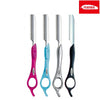
A texturising razor is a handheld cutting tool with a guarded blade, designed to thin, taper and add movement to hair without the blunt lines that scissors leave. Unlike a straight razor used for shaving, a texturising razor (also called a styling razor or feathering razor) has a protective comb or guard over the blade that controls how much hair is removed with each stroke. It is one of the fastest ways to create soft, wispy texture on medium to thick hair.
How a Texturising Razor Works
The blade sits behind a comb-like guard that lifts individual hairs and exposes them to the cutting edge. As you stroke the razor through a section of hair, the guard controls the depth of the cut. Some hairs are caught and cut at different lengths, while others pass through untouched. The result is a soft, feathered texture that blends naturally and moves with the hair.
Most texturising razors use replaceable blades, and Feather is the brand that dominates the professional market. Feather razor blades are made in Osaka, Japan from high-carbon stainless steel and are ground to an edge that is sharper than most surgical scalpels. A fresh blade glides through hair without dragging or pulling. A dull one will tug and damage the cuticle, which is why you should replace blades after every three to five clients.

Texturising Razor vs Straight Razor
This is the most common point of confusion. A straight razor has a fully exposed blade and is used for shaving, clean line-ups and skin fades. A texturising razor has a guarded blade and is used exclusively for cutting and texturising hair on the head. You cannot shave with a texturising razor (the guard prevents skin contact), and you should not texturise with a straight razor unless you have advanced training and extremely precise control.
| Feature | Texturising Razor | Straight Razor |
|---|---|---|
| Blade Guard | Yes (comb guard) | No (fully exposed) |
| Primary Use | Texturising, thinning, tapering | Shaving, line-ups, skin fades |
| Skill Level | Intermediate | Advanced |
| Blade Type | Replaceable (Feather, Kai) | Fixed or replaceable |
| Risk of Cutting Skin | Very low | High |
Types of Texturising Razors
There are three main types you will see in salons and barbershops. The standard styling razor has a straight handle and a single guarded blade. It is the most common type and the best starting point for beginners. The thinning razor has a wider guard with more teeth, designed for removing bulk from thick hair quickly. The feathering razor has a finer guard that creates very subtle, wispy texture. Some brands like Feather make all three types with interchangeable handles, so you can switch guards depending on the result you need.
How to Use a Texturising Razor
For a detailed walkthrough, see our full guide on how to use a styling razor. Here is the short version:
- Work on damp hair. Dry hair creates too much friction and the blade will drag. Mist the section lightly before each pass.
- Hold the razor at 30 to 45 degrees. Angle the blade away from the scalp, with the guard facing the hair. Never push the razor towards the roots.
- Use smooth, downward strokes. Start at the mid-lengths and stroke towards the ends. Each pass should be one fluid movement, not short choppy ones.
- Check after every two passes. A texturising razor removes more hair than you expect. Go slowly, check the result, then add more if needed.
- Replace the blade regularly. A dull blade pulls and damages the cuticle. Swap it out every three to five clients, or sooner if you feel any dragging.
Who Should Use a Texturising Razor?
Texturising razors are brilliant for barbers and stylists working on medium to thick hair that needs movement and body. They are especially useful for shaggy layers, curtain fringes, and any style where the ends need to look soft rather than blunt. They are not ideal for fine or thin hair (you will remove too much), very curly hair (unpredictable results), or damaged hair (the blade can worsen existing breakage).
Frequently Asked Questions
What is the difference between a texturising razor and a straight razor?
A texturising razor has a comb-like guard over the blade that controls how much hair is removed per stroke. It is used for thinning, tapering and adding texture. A straight razor has a fully exposed blade and is used for shaving, line-ups and skin fades. The guard on a texturising razor makes it much safer and easier to use, but it cannot be used for shaving.
Can you use a texturising razor on curly hair?
With caution. Curly hair shrinks when dry, so what looks like subtle thinning on wet, stretched hair can become a dramatic reduction once the curls spring back. If you use a texturising razor on curly hair, work on dry hair, use very light strokes, and check the result frequently. Many curl specialists prefer scissors-only techniques for better control.
How often should you replace texturising razor blades?
Every three to five clients, depending on hair thickness and the number of strokes per cut. A dull blade pulls and damages the cuticle instead of cutting cleanly. If you feel any dragging or tugging, replace the blade immediately. Using Feather or Kai blades will give you the sharpest, most consistent performance between changes.
Tags
Blog posts